Showing posts with label special needs. Show all posts

Tuesday, December 18, 2012

A Review from "Welcome to THE Show!"

"Welcome to the THE Show" was great!!

-->
In the videos from rehearsal, I saw the process of writing the show. First, they worked together to tell the story. Each person continued it. Then, they memorized the outline of the story and started improvising scenes. Michelle, the director, typed up the script based on what they said. Then, they rehearsed it. And last week was the performance!
            I think part of this was easy and parts were hard.  I think it’s hard to put on a play because some people get nervous. Coming up with the story and writing the whole play might have been hard, too. But, it looked like everyone was having fun! So maybe it was easy.
I think the show was funny because it talks about the put on a play with the producer getting mad. My favorite part of the play was the argument of the director and producer because it shows that the director is doing his job. My favorite character was the director because she did an awesome job putting the play together.
I think the producer learned he needs to stick with his job and just be a producer. At the beginning of the show, he was mad and didn’t want anybody to talk to him. He was mean. He didn’t get to perform in the final show. He was fired because he was so angry and he didn’t want to be involved—he took a phone call in the middle of rehearsal! But at the end, he apologizes and asks to have his job back. The group forgives him.
If you get the chance to see the show, you should. “Welcome to THE Show” tells a story about working together and sticking with the group. It’s funny, and I think people would like it. Here are some pictures from the show:

Meet the Cast!!

Michelle talking to the cast before the show

Emily D. and Bianca rehearsing

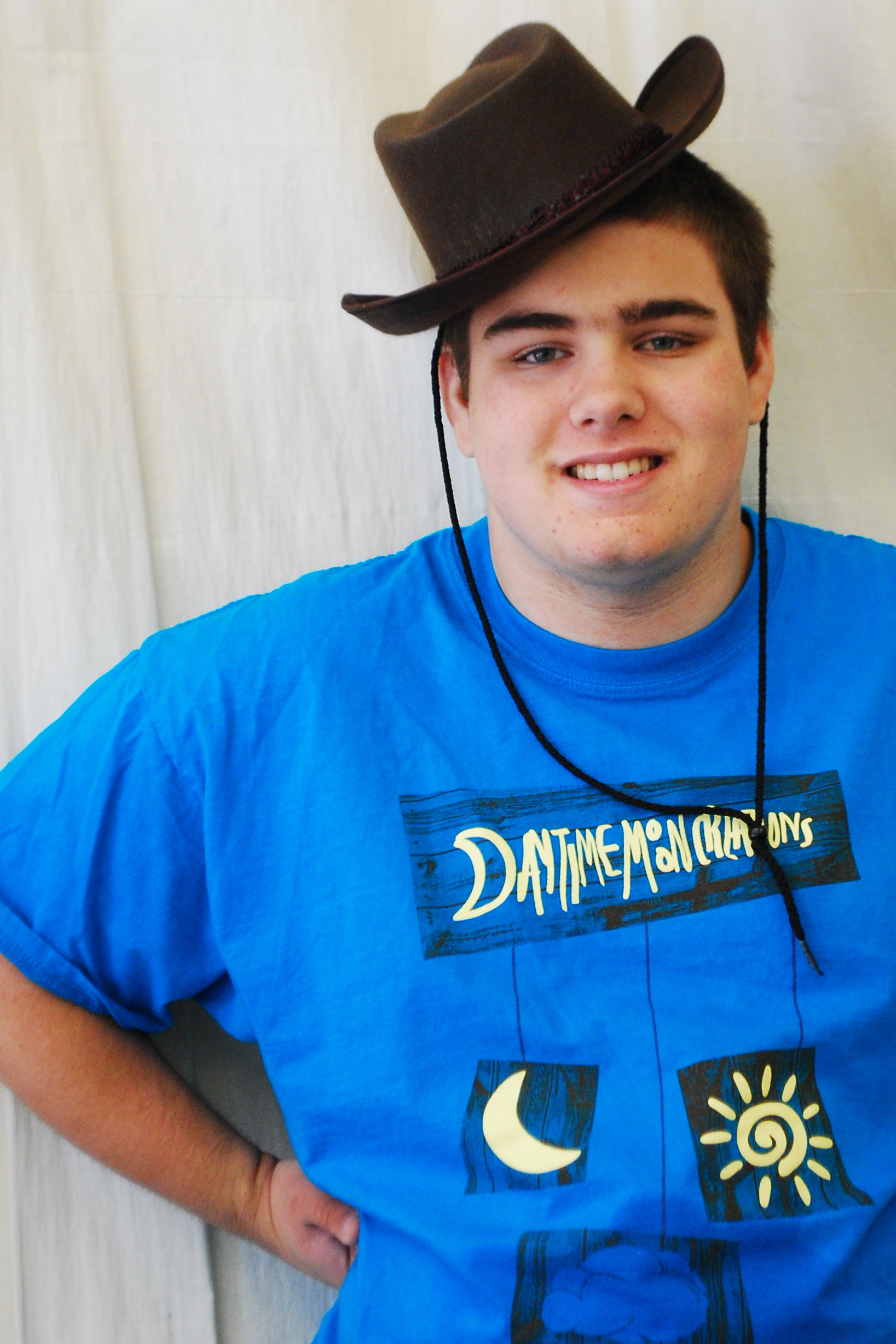
Jacob is ready for the show!

Michelle introducing the show

Jorge as the producer

Bianca and Christina in the show

Emily S. as the director

Jadzia and Jorge

The cast getting for opening night in the play

The producer comes back to apologize


The whole cast celebrating "Welcome to THE Show"

You should come to Daytime Moon’s next show! Because it’ll probably be good like this one was.

Jareth

Sunday, November 25, 2012

An Interview with Michelle Kuchuk

Hello!

Hope you had a wonderful Thanksgiving! 


Last week during our weekly meeting, Jareth came up with a series of questions for Michelle and for the actors at the CCA SKILLS Program, so that we can give you an inside look at the making of a Daytime Moon show. In this post, I'm thrilled to share Michelle's answers. At the next rehearsal, she'll pass them along to the actors and Jareth and I will share them as well.

So, without further ado... I give you, Michelle and Jareth!

Jareth: Hi Michelle! I thought it would be cool to do a blog post that would give readers more information about Daytime Moon and the show, so thanks so much for taking the time to answer these questions. Some are about the show, and some are about you. Let's start with the ones about the show. 

Who comes up with the story of the play?  How do you make the play? What’s the hardest part? What’s the easiest part?

Michelle: The actors actually come up with the story!  Through a bunch of different theatre games, different stories are told and a couple usually start to become popular with everyone.  After we narrow it down to two or three different ideas, we come up with scenes for each choice.  THEN ... one usually becomes the most detailed, and then as a group, we figure out all the details of the beginning, middle, and end!  Between classes, the teachers transcribe what all the actors said in class, and come in the next class with an actual script.  The easiest and most fun part for me is watching the actors come up with the stories and the dialogue themselves.  The hardest part is sometimes narrowing all the ideas down to fit into one script ... but usually we just combine ideas anyway so it ends up being okay!

J: Who casts the show?
 
M: Based on the story we create, the actors cast themselves.  I challenge the actors to come up with the characters we need, and after performing in scenes as exercises, they've already experienced different characters.  After coming up with all the details of the plot, we all discuss who would like to be who.  Everyone walks away happy because each character has lots to do!

J: Last year, I worked backstage on CCA's production of "Peter Pan". For “Peter Pan,” I had to stay backstage and be quiet. Some of my other responsibilities were to read the lines so I knew when things would happen. Then, when that line happened, I knew to open or close the curtain. What will the responsibilities of the crew be? Does the crew need to be quiet for this play, too?

M: The crews' responsibilities are mainly like yours in "Peter Pan," Jareth!  The actors and the crew have to read the lines so they all know when to enter and when a certain scene is ending.  Sometimes, actors backstage might have to say something from offstage, but usually everyone does need to be quiet backstage.  

J: During “Peter Pan,” the actors needed to rehearse their lines and practice. How many times do these actors practice? 

M: We have seven classes all together before the final performance.  Actors usually practice their lines at home once they get the script - but I'm never sure how many times they practice, exactly. They are always prepared, though, so they must be practicing a lot!

J: How long does it take to rehearse for the performance?

M: The actors will have the script for three classes before the show, and then there is a quick rehearsal in the theatre before the audience comes in!

J: Where does the show take place? What is it about?

M: The show takes place in a theatre, actually!  It's about a group who want to put on a Broadway show ... and the rest is a surprise.  

J: How many times will the show be performed? When will it be? How can people get tickets?

M: The show will only be performed once!  It will be held at the Peoples Improv Theater on December 13th at 4:45PM. Once tickets become open for reservations, people can email information@daytimemooncreations.org to reserve seats, which are free.

J: Awesome, and now I'd like to ask some questions about you.

Tell me about yourself. What do you do?

M: In addition to being one of Daytime Moon Creations' staff and teachers, I also am the Literary Director for a company called Nicu's Spoon Theater, and a freelance director.  I also sing, tap dance, and am a Special FX makeup artist around Halloween.  

J: What are your favorite plays? 

M: The hardest question!!  There are so many incredible plays out there ... I really love the plays of Edward Albee, Martin McDonagh, Tracy Letts ... to name only a few... 

J: What is your favorite play you’ve ever directed?

M: Another hard question!  I think the most meaningful directing experience for me was directing a show called Beautiful Thing with Nicu's Spoon Theatre.  

J: How did you become a director? What made you want to?

M: I discovered directing in college (having only performed growing up), and the classes I took completely changed my perspective about directing, the process involved, and what a director can accomplish by merely guiding the actors to her semi-imagined result.  I love how theater and directing and acting is one big collaboration: the more everyone works together and contributes their ideas, the richer the play will be.  

J: How long have you worked with Daytime Moon?

M: I've worked with Daytime Moon for two years!

Thanks so much to Jareth and Michelle for a great interview! Hope you enjoyed this behind-the-scenes look at Daytime Moon's latest production. Stay tuned for more videos and stories!

Cheers,

Jenna

Friday, November 9, 2012

Introducing Our Newest Blogger!

Hi everyone, I'm Jareth! I'm 16 years old and I go to school at the Cooke Center Academy. I'm a new intern at Daytime Moon and I'm really excited to be working on the blog. Every week, I'm going to be helping write the blog. I'm going to go through the videos from each class and pick the ones that are really good. Then, I'm going to write about them and share them! When I'm not with Daytime Moon, I like to hang out with friends, watch movies, and have free time on the computer. 

I watched the videos from yesterday's class. They were really funny, really nice! The first game was called "Yes, And." In this game, everyone says a sentence to tell the story. They made four stories. There were two that I really liked. Here they are!


In this story, there's a kidnapped prince who's locked up in a closet. He's so mad. Then, he broke out to find some friends. He finds a friend and they go to a baseball game together.
 
I liked this story. This story might be like a fairy tale, imaginary.


In this story, they're putting on a Broadway show. One of the actors got so sick that he missed rehearsals. When he feels better, he comes back but they cut him from the show because he missed everything.

This story might happen to a Broadway show, so it's more realistic. But if I were sick and got cut from a show, I'd feel mad. It's my part!

After they played "Yes, And" the group made scenes. Some of the scenes were based on stories from "Yes, And" but not all of them were. I chose my two favorites and here they are!


In this scene, the prince is locked up. He feels sad, mad, and scared. One of his friends comes to save him because they have tickets for the baseball game!

I liked this scene. It was based on the story of the Prince that the group wrote earlier. I think they did a good job.


In this scene, two people were having a dance party at the library. Someone who was trying to study comes in and says they can't do that. She gets the librarian, who kicks them out.

I liked this scene. I thought it was funny because they were having a party in the library, maybe because they wanted to because they were bored. But that's not allowed in the library.


So that's this week's blog! I hope you enjoyed the movies. I had a lot of fun today.

See you next week!
Jareth

Friday, November 2, 2012

Learning to Teach, Teaching to Learn

You know that age-old expression that goes something like, “I ended up learning more from them than they ever learned from me”?  Whoever said it first really nailed it – especially when it comes to working with Daytime Moon.  On the other hand, it’s not necessarily an outcome one intends or strives for as a teacher…

Let me explain.  I’ve been involved with DMC for two years, and every moment with our students and actors proves that old expression true and true again.  I firmly believe that our actors grow and learn so much in our short time together, but I always feel humbled by all the lessons they end up teaching us!  So as I geared up to start this year’s fall session at Cooke Academy (my first program as head teacher!), I thought to myself, “Well, hmm… I need to do Daytime Moon Creations and these actors proud and instill lots and lots of amazing things unto them” – since I would inevitably learn so much from them, I wanted to make sure to try extra hard!!

And so far, it’s been great: exploring new and old games, meeting new faces and catching up with our alumni, but it was all moving very fast.  As I walked home from our second class, my own nerves and huge desire to be the best teacher I could possibly be threatened to take over my thoughts, and as I started to think about the following week’s lesson plan, I started to get distracted by insecurities and those darn nerves.  So as is my wont to do, I caught up on a little neuroscience research, and made a couple of very important realizations about teaching.  We are intrinsically an exploring species.  And everything we do at Daytime Moon has always supported this: that we need to harness this wandering, this exploration, and create and play and make mistakes and learn from them.   We may sort of believe this to be the truth (that we should learn from our mistakes), but it’s usually easier said than done!  Most of us would rather just get it right the first time!  But we actually get way more out of everything if we do make mistakes – though we are only going to want to keep making mistakes if we are in an environment that makes it totally okay to do so. 

I realized this mistake-making needed to carry over to the teacher’s (my own) mentality as well.  If I was allowed to fail, I could really give it my all.  Though the chance for mistakes might be greater,  I wouldn’t watch myself, I wouldn’t be afraid, and I’d be demonstrating that the class needn’t be afraid either.  That it’s okay!  Teachers, of course, should be as prepared as best as he or she can be.  And I can be completely prepared and get the support I need from Jenna and from my assistant teacher Ella, but that after all the preparedness, I just needed to plunge in!  That it’s okay for me to learn and pick myself up and discover and learn and grow because I am enabling my students to do the same thing.  The way a teacher behaves has more impact on students than how much a teacher knows.  Daytime Moon’s mission seeks to create a joyful environment where we can play, where we can make mistakes – but here I was not affording that to myself!

Truly, the most important thing that we at Daytime Moon strive to keep in our classes is joy.  The brain rewards itself with joy after successes – which aren’t necessarily mutually exclusive with “The Destination.”  The process is sometimes more rewarding than the end goal itself!   And though many of us believe this to be true, it’s true neurologically as well.  We turn our energies to the things that are ours, the things we want to create, to learn, to move through the process of, to challenge, to overcome.   My students will begin to create and to write their own play next week.   And I am teaching those students.  We can own our own processes.

Maybe it’s not who learns the most.  Maybe it’s something we all experience together, helping each other in our discoveries.  It’s comforting to know that we are all in this process together, that we can grow together.   The following is something I hope to keep present in every class, but that I now know applies to my own teacher journey as well: “The joy of learning is indispensable in study as breathing is in running.”  How very true.

Michelle

Finding the Joy

Hello everyone!

From all of us here at Daytime Moon in the wake of Hurricane Sandy, I hope you and your family are safe and sound. I hope the impact was minimal and your personal recovery moves quickly. In times of great loss, I never cease to be amazed at the resilience and compassion shown in this city. I see kindness towards strangers, sharing of resources, and a determination to bounce back better, stronger, and a little more aware of those around us. In these times, when we can so easily feel overwhelmed with sadness, what I find most beautiful are the moments where people come together to create and share in joy. The Daytime Moon community is no different; we feel the pain that has been caused by Sandy, but we comfort ourselves knowing that our work is full of joy. So, despite a heart heavy with the images of my fellow New Yorkers in pain, I am choosing to look at the moments of bravery, of compassion, and of joy.  I hope you will join me as I share updates from Daytime Moon's fall program.

As many of you know, this fall finds Daytime Moon Creations back for our third program with the Cooke Center Academy SKILLS Program and Alumni Association, where we are working with a group of young adults to develop an original play! The program started 3 weeks ago and it's been amazing so far.

As Daytime Moon grows and expands, I've personally felt very lucky to see the caliber of volunteers and artists who want to work with us. You all have, I'm sure, seen the incredible work of Michelle Kuchuk, who has worked with Daytime Moon for two years now: first as a one-on-one buddy and most recently as my assistant teacher. I am overjoyed now to introduce her now as a head teacher! Michelle is teaching this program at SKILLS, and I'm excited to welcome Ella Metuki, also a former one-on-one buddy, as her assistant teacher.

I had the great pleasure of observing their class last week and had a blast! They have a lot of familiar faces in their class, but also a lot of students experiencing Daytime Moon's programming for the first time. It was exciting to watch as the returning students took on leadership roles in the room and the new students were so willing to explore their imaginations.

Check out some of the videos from class!

This clip is from a game of "ImaginAIR," where the group was exploring space. Here, Jorge is pretending to be an astronaut and encounters Emily the space creature!


In this clip, taken during a game of "Group Photo," a group of students works with Michelle to create a snapshot. Can you guess where the photo was taken?


In the live action follow-up to "Group Photo", Charlie, Emily and Michelle share a short skit with the group. Can you guess where they are?


The final show is scheduled for December 13th at 5PM at the Peoples Improv Theater. I don't know about you, but I'm already counting down the days!

Wishing you continued strength, calm, and JOY during the ongoing recovery,
Jenna

Thursday, September 20, 2012

Introducing... "Difficult Lines"

Here it is... The final film from Daytime Moon's Film Class with Ben Sidoti!

"Difficult Lines" tells the story of two actresses working on a play who fight because one can't remember her lines. The director has to step in to help settle the dispute. "Difficult Lines" was written by the group--Safia, Samy and Jake--and created entirely by them. Safia and Samy each took a turn behind the camera, shooting two shots each and then switching to run sound. Jake consulted on the staging and camera placement, then portrayed the director. Emily and Courtney, two Daytime Moon volunteers, stepped in to play the fighting actresses. 

Check out the final movie:


Pretty amazing right?!?

Congrats to our whole cast and crew, and thanks to Ben for a great class!!

Friday, September 14, 2012

Guest Post from Film Teacher Ben Sidoti!

Hello!

I remember the exact day that filmmaking entered my life. I was sitting in class my first week as a Freshman in high school and Ms. Jensen, who would become one of my favorite teachers, came in to our class to invite us to join her filmmaking class the following semester. While I had always been interested in movies, it was never something that crossed my mind as a profession or something that I could actually do for fun. I always thought you needed expensive cameras, lights, and sound equipment, but she opened my world to the idea that a great story, built from imagination and creativity is all you need. From that day on, there hasn't been a day where filmmaking hasn't been a part of me. 

I'm very excited to have to opportunity to try and spread my love and enthusiasm for film tomorrow. With over 10 years working with cameras, editing software and everything else that comes with video, as well as plans to teach filmmaking someday, this opportunity is one I've wanted for years, and I can't wait to meet all of our participants and create something awesome!

Want a front row seat to all the action in class? Follow along for real-time updates from students on Twitter @Daytime_Moon; Instagram @Daytime_Moon; YouTube at www.youtube.com/user/DaytimeMoonCreations and Facebook at www.facebook.com/DaytimeMoonCreations.

See you tomorrow!
Ben

Thursday, September 6, 2012

From the Archives- Today's Creating a Character Class with Jenna Gabriel


July 22, 2012

Hello Again!

I was pretty excited going into today’s class, and very anxious to share my love of creative characters with the group. I was so lucky to have such a receptive and enthusiastic group!

As our warmup, I asked everyone to share their favorite character of all time and act out a favorite line of theirs. We saw everything from Homer Simpson to The Joker to the Witch Doctor from “Princess and the Frog.” After getting all of the different characters in our bodies, we sat for a few minutes to talk about the different kinds of characters that there could be. It’s tough to extrapolate the big picture from favorite characters, to recognize that Superman is a specific character while Hero is the archetype, but our group was able to name a lot of types of characters!

I had been prepared with pictures of a few:

Types of Characters: a King

Types of Characters: a Villian
Types of Characters: a Villain

Types of Characters: a Parent and a Child

Types of Characters: a Hero

Types of Characters: a Lover

Types of Characters: a Clown

but they surprised me by adding a few characters into the mix that I hadn’t thought of, like a detective!

Then, the conversation got even more complicated as we talked about how within different types is where the fun is: What makes two heroes different from each other? Two kings? Two villains? The group was dead on with their answers: how they feel, how they act, and what they wear. Amazing, right?!

Which brought us to the crux of class: creating our own characters! It started with the “what they wear” part of character, as each student picked a costume piece and began exploring the many different ways they could wear it. Once they’d settled on one, I photographed them each in costume with their face expressing everything the costume made them feel. And together, the group answered questions based on those photographs to help each other flesh out their characters: What do you see? What is the costume piece? What emotions does it look like this character is feeling? What type of character is this? What do they do? Where are they from? What is their name?

Teddy trying on his costume piece

The class answers to character questions about Nicky's character, Rocky
The class answers to character questions about Nicky’s character, Rocky

Teddy's photograph as the class discusses his character
Teddy’s photograph as the class discusses his character

And finally, these characters all got to meet each other and go on an adventure! We traveled from the hills of Britain to the woods of Australia, we saw zoos and magic carpet rides and bullfights… It was amazing!

 Here are their final characters:

Nicky as Rocky the Australian Cowboy

Kendall as Kevin the Wolf

Teddy as John the Magician

At the end of class, Teddy shared that he loved being able to play at Daytime Moon, and that he’d learned that “there were many unlimited ways of creating a character.”

Successful class? I sure think so! But check out the highlight reel to see for yourself:


See you next time!
Jenna

From the Archives-Creating a Character!


July 20, 2012 

“An idea has no worth at all without believable characters to implement it; a plot without characters is like a tennis court without players. Daffy Duck is to a Buck Rogers story what John McEnroe was to tennis. Personality. That is the key, the drum, the fife. Forget the plot.”
—Chuck Jones

***
 
I love this quote. Because it’s so true, right? “Boy meets girl” would always be the same story if it weren’t for the specific boys and the specific girls. “Whodunnit” would always be the same mystery if it weren’t for the unique quirks that every villian leaves in their wake as clues. At their core, every character is an archetype: a mother, a lover, a villian, a hero. At their core, every character is a human. And so, creating a character both takes us far outside the realm of who we are and brings us much closer to understanding our core as a human. Embodying another person asks of each of us to understand the drives and feelings of another person, to be (even when the character is cruel or greedy or angry) empathetic to a fault.

It’s work that I’ve always loved doing as an actor, and work that I’m thrilled to share with the students in Daytime Moon’s “Creating A Character” workshop tomorrow afternoon. In all of the full programs I’ve taught, we’ve put so much emphasis on the story that character work has always been secondary. We explore our students’ characters through the lens of their experience within the plot. But, as Chuck Jones so eloquently commands: forget the plot! In my class, we’ll have two hours to simply focus on character. We’ll be creating individuals that maybe one day we could make a story out of, who surely could meet each other in the street or at a party and find some adventures to embark on. But the crux of what we’ll be doing Saturday is simply to find the people–Who are the craziest, funniest, most exciting people we can imagine? And how can we imbue them with a backstory so they become living, breathing, feeling beings?

Check out some of these examples of epic archetypal characters. So much fun to play with!

For the past few weeks, I’ve been watching all of the other workshop teachers have a blast with our participants. I’ve observed their classes, have taken photographs and videos, and helped participants tweet their experiences during breaks. It’s been inspirational and enjoyable, but more than anything I’ve felt the itch to play! Watching the other amazing teachers bring so much joy to our students is like sitting on the bench as the rest of the lineup bats through the order. Finally, I feel like I’m in the on deck circle, and I’m so excited to see the students tomorrow I can hardly wait!

If you can’t make it to class, I hope that you’ll follow the students’ experiences on twitter @Daytime_Moon, on our Facebook page at www.facebook.com/DaytimeMoonCreations, and on YouTube at www.youtube.com/user/DaytimeMoonCreations. I can’t wait to share all our updates with you!

One of my favorite Chuck Jones creations. Even if he's the "bad guy" in the roadrunner cartoons, you can't help but feel badly for him. Wile E. Coyote is such a classic character!
One of my favorite Chuck Jones creations. Even if he’s the “bad guy” in the roadrunner cartoons, you can’t help but like him. Such a classic character!


So join me tomorrow as we play with “the key, the drum and the fife.” We’re having fun with personality! Plot-free.

See you in class,
Jenna

From the Archives- Yesterday's Dance Class with Michelle Kuchuk!


July 20, 2012

In her blog entry before yesterday’s class, Michelle wrote about the many positive cognitive effects of dance. She discussed the neural pathways that are reinforced, the effects of physical imitation-style learning, and of the body’s ability to remember what it has kinesthetically learned. As insightful as her entry was, her take home point was much less academic, much more focused on the simple JOY of expression.  I’m sure that yesterday’s class was not quite what Michelle expected–when sickness and last minute cancellations effected enrollment, we ended up with only one student in the class, one teacher and two support staff. But that room was FULL of joy!

Kendall is no stranger to Daytime Moon staff or programming, so Michelle was able both to stick with her original lesson plan and make adjustments according to what we know to be Kendalls’ interests. She began with a movement warmup and stretches, getting Kendall and the other two group members, Ella and Emily, warmed up and into their bodies. The group explored different types of movement and how dance can be used as a medium through which to express emotion. After Michelle got all the heart rates up, the group took a breather to watch some videos Michelle had brought in that exemplified different types of dances: ballet, jazz, tap, etc. My personal favorite moment in this was Kendall’s statement that “There’s breakdancing on the floor. Ballet is like the nutcracker dances and men in tights. And jazz is like cool guys in glasses.” Pretty dead-on if I do say so myself.

The group during warm-up

Emily and Kendall Dancing

Michelle and Kendall dancing the macarena

After looking at all of the different kinds of dances, the group started to talk about what kind of a dance they’d like to create. Kendall said he’d like to create a dance that was scary. He’s very interested in wolves and so he led the group through the story of his favorite character, the Teen Wolf, who is a werewolf. As a human, the Teen Wolf is made fun of, but as a wolf everyone likes him. Kendall and Michelle talked about how this was a situation in which the Teen Wolf would also feel very scared, and together they choreographed a dance sequence that takes the audience through the Teen Wolf’s ostracizing experiences, then to a final fight where the crowd realized that the human and wolf are one in the same. Eventually, everyone accepts the Teen Wolf for who he is inside.

Check out the final performance:


It was really exciting to watch! I hope that, if you missed it, you’ll go back and read the Tweets from the classroom, and check out the Facebook page for other updates. And most importantly, we have the highlight reel from yesterday’s class posted to Daytime Moon’s YouTube channel at www.youtube.com/user/DaytimeMoonCreations.

See you tomorrow at noon for my class, Creating a Character!

Cheers,
Jenna

From the Archives- Dance with Michelle Kuchuk, Guest Post!

July 19, 2012

Two blog posts in one day, you ask?!?! Ahhhh, the joys of summer programming. With her class starting tomorrow, Michelle Kuchuk took some time to journal about the many reasons she’s excited to teach tomorrow’s Dance workshop. 

Most of you know me as the embarassing-ly silly teacher in Daytime Moon’s past programs, but those of you who know me well know that I am incredibly invested in the academic relevance of everything we do here at Daytime Moon. It may seem like we just like to have fun, and certainly that joy is the centerpiece of all of our programs, but there is a substantial amount of scientific data supporting every curricular choice we’ve made. If you’ve gotten a chance to read the article Emily shared with you the other week from Autism Spectrum News, called “Everyone Can Play-Using Theatre to Promote Developmental Gains,” you’ve seen some of the scientific support for theatre. But Michelle has taken this opportunity to share some exciting research about her discipline, Dance. And it’s mind-blowing!

So, from one nerd to (I hope) many more, it gives me such joy to share with you Michelle’s journal. I hope it’ll resonate with you the same way it resonated with me, and that you’ll join us on Facebook,  
Twitter and YouTube tomorrow at 4PM for all of the updates from her classroom!

Cheers!
Jenna

And without further ado… MICHELLE!
***

Most of you know me as Jenna’s assistant teacher for all of our regular programs, but tomorrow I’ll be teaching the dance workshop as part of Daytime Moon’s summer series!  My mom used to be a choreographer and danced for most of her adult life, and I probably watched Gene Kelly or Fred Astaire tap their way into a frenzy on the day I was born (her favorite movie of all time being “Singin’ in the Rain”).  I’ve been dancing at least in some sort of capacity since I was three, having fallen back in love with dance in the last two years, so I was therefore incredibly excited when Jenna asked me to teach our dance workshop!  Since I’ve now been working with Daytime Moon for a year and a half, I was also really excited to figure out how I could apply this particular medium into our usual methodologies and reasoning behind our classic theatrical programming. 

As it turns out, there is a lot of exciting and newer research to be learned about some of the benefits from learning a skill such as music or dance – benefits that you might think you could guess (as I did), when in reality, the research reveals far more than what is typically held to be common knowledge. 

I’ll start at the beginning.  The great thing about dance whether you’re Michael Jackson, a Daytime Moon student, the star of Swan Lake, or me, is that while learning a new dance step does require some verbal instruction, we can only dance anything complicated after forming nonverbal knowledge, commonly known as muscle memory.  (In actuality, the phrase ‘muscle memory’ is a bit of a misnomer as it is our brain networks, and not our muscles, that store memories of movements.  These memories can therefore be more correctly referred to as motor memories.  The important point, though, is that these motor memories are specific to movement and distinctly different from the memories of the verbal instructions of the same action.)  I can tell you about a pliĆ© in ballet or a time step in tap until I’m blue in the face, but you’ll only even begin to interpret the step until you see ME do it, and only truly learn it if YOU do it. 

WHAT?!  First of all: does the chunk of the brain that gets activated when my student sees me perform a dance step get activated when he performs the same step?  Research has shown again and again that there is a huge overlap, that certain networks of the brain get activated when both doing and observing the same action.  Does the network get more activated if the student was already a pro at the step he was watching me perform?  Yes: a network in the cortex called the action observation network becomes even more active when we watch a step that we are already physically familiar with.   This body of research suggests that the action observation network is a ‘general-purpose observational learning network for simulating actions, and it is cued by both physical and symbolic models.’  We learn better by DOING. 

WHAT?!  Schools typically emphasize reading, writing, and math because these subjects are supposed to produce development in reasoning, abstraction, and semantic knowledge.  The only reason P.E. is probably still in some curricula is because of the health benefits – I know I’m not alone in remembering how I ‘got out of it’ in order to take more advanced classes in history and English.  Courses focusing on physical knowledge such as wood shop, music, dance, and theatre are being cut, and are often only ‘saved’ when these mediums are thought to help with academic learning.  We assume that anyone with sufficient cognitive abilities can gain physical knowledge if they just put their minds to it; this interpretation of the relationship between ‘knowing’ (cognitively) and ‘doing’ is false, and yet it dominates educational policy and practice today.  Any importance placed on the arts is viewed through the lens of helping a child learn the core subjects.  I’m sure most of us (me included) have defended the arts in this way, and it’s an extremely important and valid point (which I’ll explain in more depth in just a sec) … but it’s actually not the whole story.  All of those crazy sentences about action networks and observational learning show us that a whole wealth of ‘other’ knowledge comes from experiencing the physical world – knowledge that is separate from and not JUST supporting cognitive knowledge and training.  Experiential knowledge is inherent in creating surgeons, scientists, innovators, truck drivers… the list goes on.  Their learning comes from observational and imitative learning, which this action observation network facilitates. 

…But yes, there is a whole ton of ongoing research that supports the fact that learning and performing an art – if we practice a lot and are truly engaged – strengthens the brain’s attention system which improves cognition more generally (measured by IQ scores, among other means).  Attention plays a crucial role in learning and memory, and this, without question, improves cognitive performance.  It might seem obvious, or something you kinda just assumed was true, but it’s actually pretty scientific: our brain changes according to what we do, in other words, our behaviors shape our brain.  If we find an art that we like and it completely engages us and then we stick with it, learning and memory (especially) will improve.  The more and more we practice our clarinet, the more and more efficient that specific clarinet brain network becomes.  And because everything in the brain seems to happen in conjunction, this increased efficiency in the clarinet network causes all of our other attention networks to become more efficient, like, for example, a network called the executive attention network.  This particular network is especially interesting because it helps us control our emotions, and choose among conflicting thoughts in a specific moment (should I play the B flat or the A minor?) in order to focus on our long-term goals (I want to be a musician, graduate high school, etc).  These abilities are also important in creating social and academic success by helping to develop empathy and manage impulses.  Getting back to dancing specifically, it has been shown that empathy can also be gained from movements alone: after watching dance clips, observers could gauge whether the dancer was happy, sad, or nervous based only on their body movements. 

The last yet extremely important facet of teaching the arts is based around finding passion.  The need or want to learn the skills of music, dance, theater, painting, film, or building your own guitar is a source of important motivation that spreads to all aspects of any learner’s life.  Our brain is an unbelievable and curious entity, and research is showing more and more how brain systems are actually driven by passionate interests and physical skills.  This is not to say that every single person out there is going to learn ‘better’ by engaging in some sort of art form.  But when kids find that particular artistic endeavor that they really love, you’d be hard-pressed to find another subject that would produce such strong and sustained attention that happens to also be incredibly rewarding and motivating. 

So what the heck do I want and expect from my workshop tomorrow?  This is a one-time workshop and will be an introduction to just getting in our bodies while having a whole bunch of fun, but I guess this blog illustrates a few of the reasons why we wanted to introduce our students to different mediums: so they could find the art form they loved best but still experience it in the context of the practices and approach of Daytime Moon.  With dance, it’s nice to know that not all learning has to be so verbal – even though we are engaging our minds.  Dance gets into our bodies and our brains in ways that just maybe, we never really expected.  

I’ll be blogging again after my class tomorrow (and I promise to leave out all talk of observation networks) but I’ll leave you with this: I was four years old the first time I was ever onstage.  I was in a dance recital, and we were all lions.  We took our bows, and then 4-year-old Michelle sneaked back onstage for a second bow.  In tomorrow’s class, I hope to include not only lions, but the joy that must have been at play for me to have bowed twice.

Don’t forget to follow along on all our social media!

See you in class,
Michelle